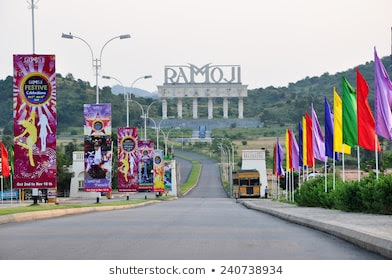
Ramoji Film city (RFC) is a”HEAVEN OF THE WORLD”and also wonder of world, Ramoji film city the thematic holiday destination in india with cine magic in R.F.C. Not only tollywood bollywood films made in RFC but also HOLLEY WOOD FILMS and daily serials of tv made in ramoji film city
Ramoji film city is a beautiful place and providing variety of options to explore including adventure rides different type of garden.Every person of world must visit RAMOJI FILM CITY in their life,RFC given lot of fun exiting entertaining happiness not only film making it also entertain to people , RFC largest integrated film studio complex in the world, the place is splendor and popular family gate way
LOCATION
Ramoji film city located northern part of deccan plateau in rangareddy dist in Hyderabad Telangana state, in India RFC CONNECTED BY NATIONAL HIGH WAY 65 ramoji film city 25 kilometer near by hyd
LATITUDE LONGITUDE
17.2543 NORTH LATITUDE
78.6808 EAST LONGITUDE
MSL( mean sea level)
Ramoji film city located 536 meter OR 1758 ft above sea level
CLIMATE
The climate of Hyderabad or Ramoji Film city features an arid climate. The days are hot and dry, usually rising to extreme highs of 40 °C (104 °F), while the nights are cool and breezy. Winds usually bring along clouds of dust, and other people prefer staying indoors within the daytime, while the breezes in the dark are pleasant and clean.
In recent years Hyderabad has seen heavy downpours. In February 2003, Hyderabad received 105 millimetres (4.1 in) of rain in 12 hours, thanks to a sudden global climate change .The years 2006, 2007 and 2009 saw close contenders to this record rainfall.
Winter lowest temperature within3.3 °C (37.9 °F), recorded on January 21, 1973.
Winter highest temperature in winter was 38.2 °C (100.8 °F), recorded on February 16, 1993.
spring highest temperature of spring was 46 °C (115 °F), recorded on April 2, 2002,
spring while rock bottom 12 °C (54 °F) was recorded on March 7,
summer highest temperature recorded in summer was 49.5 °C (121.1 °F), recorded on 19 June 2016,
summerwhile rock bottom 19 °C (66 °F) was recorded on May 4, 1989.
Atoms very best temperature 36.9 °C (98.4 °F) was recorded on October 8, 1987,
Atmos lowest temperature was 6.7 °C (44.1 °F), recorded on 28 November 1966.
Rainfall in Ramoji film city The average annual rainfall (January to December) for Hyderabad is 136.1 millimetres (5.36 in).The
highest annual rainfall was 455 millimetres (17.9 in), recorded in 2006.The average monsoon rainfall for Hyderabad is 100 millimetres (3.9 in)
Humayun’s place (Hindustani or Urdu: Maqbara-i Humayun) is that the place of the Mughal Emperor Humayun in city, India. The place was commissioned by Humayun’s 1st adult female and chief consort, Empress Bega Moslem (also called pilgrim Begum), in 1558, and designed by Mirak Mirza Ghiyas and his son, Sayyid Muhammad, Persian architects chosen by her. it had been the primary garden-tomb on the Indian landmass
Humayun tomb, in-built 1570, is of specific cultural significance because it was the primary garden-tomb on the Indian landmass. It galvanized many major bailiwick innovations, culminating within the construction of the mausoleum.
Humayun is a king of Mughal emperor in india , every year some millions of people visiting Humayun tomb
LOCATION
Humayun tomb located in Delhi state ,Delhi is a capital of Indian nation ,Delhi is a political capital of India,cosmopolitan city of India
LATITUDE AND LONGITUDE
28.39’21 East latitude
77.14’27 North longitude
MSL ( MEAN SEA LEVEL)
The elevation or mean sea level of Delhi is 216 meters or 719 ft above sea level
CLIMATE
Delhi is a overlap between moon soon influenced humid subtropical and semi arid with high variation between summer and winter temperature and precipitation Delhi ‘s version of a humid subtropical
In summer temperature 45 . c ( or ) 114 f
Average temperature 29 . c (or) 85 f
Rainfall 797. 3 mm
LOCAL LANGUAGE
Hindi
English
Punjabi
Urdu
Mobile Networkavailability in Delhi
Bsnl
Airtel
Jio
Idea
Vodafone
Humayun tomb is famous for
Humayun’s place is that the 1st example of Mughal design in Asian nation and is thought to possess impressed the development of mausoleum. it’s additionally noted for its distinct Persian design and happens to be the primary garden-tomb within the country.
Humayun’s Tomb Delhi Entry Fee
30 per person for Indians
500 per person for Foreign Tourists
0 per person for Photography
25 per person for Video filming
Humayun’s Tomb Delhi Timings DayTiming
Monday6:00 am – 6:00 pm
Tuesday6:00 am – 6:00 pm
Wedesday6:00 am – 6:00 pm
Thursday6:00 am – 6:00 pm
Friday6:00 am – 6:00 pm
Saturday6:00 am – 6:00 pm
Sunday6:00 am – 6:00 pm
HISTORY OF HUMAYUN TOMB
Mughal Emperor, Humayun r. 1508–1556
Capture of the last Mughal emperor Bahadur sovereign Zafar and his sons by William Hodson at Humayun’s place in September 1857
After his death on twenty seven Jan 1556, Humayun’s body was initial buried in his palace in Sanskrit literature Quila at Old Delhi. thenceforth it absolutely was taken to Sirhind, in geographic region by Khanjar Beg and, in 1558, it absolutely was seen by Humayun’s son, the then Mughal Emperor, Akbar. Akbar afterwards visited the place in 1571, once it absolutely was near to be completed.
The place of Humayun was designed by the orders of his initial woman and chief consort, Emperor Bega Moslem (also referred to as hajji Begum). Construction began in one565 and was completed in 1572; it price 1.5 million rupees,[10] paid entirely by the Emperor.Bega Moslem had been thus grieved over her husband’s death that she had thereafter dedicated her life to a sole purpose: the development of a memorial to him than would be the foremost brilliant sepulcher within the Empire, at a website close to the Yamuna watercourse in Old Delhi. in keeping with Ain-i-Akbari, a 16th-century careful document written throughout the reign of Akbar, Bega Moslem supervised the development of the place once getting back from Mecca and enterprise the pillar of Islam journeying.
According to Abd al-Qadir Bada’uni, one in every of the few modern historians to say construction of the place, it absolutely was designed by the Persian designer Mirak Mirza Ghiyas (also observed as Mirak Ghiyathuddin), WHO was hand-picked by the Emperor and brought from urban center (northwest Afghanistan); he had antecedently designed many buildings in urban center, Bukhara (now Uzbekistan), et al. elsewhere in India.Ghiyas died before the structure was completed and it absolutely was completed by his son, Sayyed Muhammad ibn Mirak Ghiyathuddin.
An English merchandiser, William oscine, WHO visited the place in 1611, describes wealthy interior furnishing of the central chamber (in comparison to the thin look today). He mentions the presence of wealthy carpets, additionally as a shamiana, alittle tent higher than the memorial, that was coated with a pure white sheet, and with copies of the Book before at the side of Humayun’s blade, turban and shoes.
The fortunes of the once celebrated Charbagh (Four-gardens) fabricated from four squares separated by four promenades, divergent from a central reflection pool. It touch thirteen hectares close the monument, modified repeatedly over the years once its construction. The capital had already shifted to metropolis in 1556, and also the decline of the Mughals accelerated the decay of the monument and its options, because the big-ticket repairs of the garden established not possible. By the first eighteenth century, the once lush gardens were replaced by vegetable patch of individuals WHO had settled inside the walled space. However, the capture of the last Mughal emperor, Bahadur sovereign Zafar throughout the Indian Rebellion of 1857 beside the premises, and his resulting sentencing to exile, at the side of execution of his 3 sons, meant that the monument’s worst days lay ahead, because the British took over Old Delhi fully. In 1860, the Mughal style of the garden was replanted to a a lot of English garden-style, with circular beds commutation the fours central water pools on the axial pathways and trees abundantly planted in flowerbeds. This fault was corrected within the early twentieth century, once on Viceroy Lord Curzon’s orders the initial gardens were improved in a very major restoration project between 1903–1909, that additionally enclosed lining the plaster channels with sandstone; a 1915 planting theme superimposed stress to the central and diagonal axis by lining it with trees, tho’ some trees were additionally planted on the platform originally reserved for tents.
In 1882, the official custodian of ancient monuments in India printed his initial report, that mentioned that the most garden was unchained to numerous cultivators; amongst them until late were the royal descendants, WHO grew cabbage and tobacco in it.
in Ronaldshay’s account of Lord Curzon a letter is quoted from Lord Curzon to his woman in Apr 1905: “You bear in mind Humayun’s tomb? I had the garden improved, the water channels mammary gland out and refilled and also the whole place improved to its pristine beauty. I visited European country last summer and, the attention of the master being away, the complete place has been allowed to revert. The garden has been let to a native and is currently planted with turnips and also the work of 4 years is thrown away! I shall drive out there, and woe hap the deputy commissioner whose apathy has been accountable.”
During the Partition of India, in August 1947 the Sanskrit literature Qila beside Humayun’s place, became major exile camps for Muslims migrating to the new based Asian country, and was later managed by the govt. of India. These camps stayed open for regarding 5 years, and caused considerable injury not solely to the in depth gardens, however additionally to the water channels and also the principal structures. Eventually, to avoid deviltry, the cenotaphs inside the sepulcher were cased in brick. within the returning years, the archeologic Survey of India (ASI), took on responsibility for the preservation of heritage monuments in India, and bit by bit the building and its gardens were improved. Until 1985, four unsuccessful tries were created to reinstate the initial water options.
An important innovate the restoration of the complicated began around 1993, once the monument was declared a World Heritage website. This brought new interest to its restoration, and a close analysis and excavation method began beneath the aegis of the Aga Khan Trust and also the ASI. This culminated in 2003, once a lot of of the complicated and gardens were improved, with the historic fountains running another time once many centuries of decline. The restoration has been endless method ever since, with resulting phases addressing varied aspects and monuments of the complicated.
Humayun’s place design
Central Asian and Persian parts became additional conspicuous within the Moslem sort of design by the late twelfth century throughout the regime of the metropolis state. It all began with the development of the Qutub Minar in 1192 AD by Qutab-ud-din Aibak of the Slave sept. The Humayun’s place are often entered through 2 double-storeyed gateways, sixteen metre-high, to the south and west adorned with rooms and a curtilage on the higher floors. and in contrast to the Taj, there’s no house of worship on the location of the Humayun’s place, instead a novel feature of this structure is that the place of Humayun’s favorite barber. Popularly cited as Nai Ka Gumbad, the place may be a fine specimen in red arenaceous rock and white marble with in depth jaali work, door frames and embellished overhang.
The place of Emperor Humayun at forty seven metres is made in Persian vogue, and is additionally the primary Indian structure to include the Persian double dome that’s 42 .5 metres high wherever the outer structure supports the marble exterior and therefore the inner one leads into the cavernous interiors. Enter the structure through the south entrance and you may now notice the serious jaali and stone lattice work. And simply at a lower place this white dome lies associate degree polygonal shape sepulture with one monument, that of Mughal Emperor Humayun. fulfil it to mention that this is often not the important sepulture, for the important one is stowed away within the crest of the world right below the higher monument. whereas this half are often approached through a passage from the skin of the most building, it remains closed to public viewing.
In the last days of the Mughal rule and through the revolt of 1857, Mughal Emperor Bahadur Shah of Iran Zafar along side 3 alternative princes took refuge here. He was eventually captured by Captain Hodson and sent to exile in Rangoon.
Charbagh
The Persian-style garden that interprets into four gardens is essentially a sq. or an oblong layout that is strictly geometrical and is split into four walkways and cleft doubly by a water body. detritus walls on 3 sides enclose the Charbagh, and on fourth facet lay the Yamuna, that has since modified its course off from the structure.
Humayun’s place alternative Monuments within the advanced
Tomb and house of worship of Isla Khan: On getting into from the west, you may see many monuments on either facet on the pathway that goes up to the most place. the foremost important one in every of the ton is that the place advanced of associate degree(more…)
“If you art lover you must visit khajuraho once in your life time”
“The central theme of these temple focus on Hindu philosophy “life reflecting the four aspect dharma ,artha, Kama , moksha “
“There is some thing that visible some thing that is suppressed and some thing is invisible and when you find these three you must understand of khajuraho temple your life is become complete”
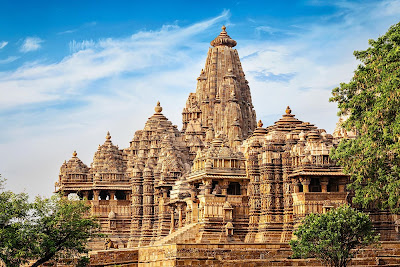
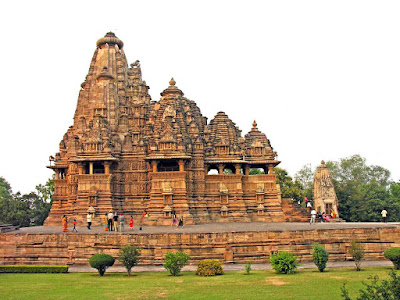
Khajuraho temple a group of monuments of Hindu and Jain religious in khajuraho belongs to 85 temples in this site its spread over 20 square kilo miters .These temple were built between ( 950 CE to 1050 CE ).The khajuraho temples are famous for nagara style and architecture symbolism and erotic sculpture .These monument mostly were built in chandeladynasty . In 85 temple today 22 temple survived( founded)
These temple are extraordinary human creative awarded by world heritage site
In 1986 these are found UNESCO ( united national education scientific culture organisation world heritage site
These are symbol of architectural magnificent disciple the height of artistic excellence reached by the artificer in ancient India. Khajuraho group of temple dedicated my two religion Hindu and Jain
LOCATION
Khajuraho temple monument are located in vindhya mountain range in central India these monument located i chatrapur dist madhya pradesh state in India .The rock bed of chhatarpur khajuraho located is bundelkhand iglesias and beloved that the oldest rock in India
LATITUDE AND LONGITUDE
24.8318452 north latitude
79.9198549 east longitude
MSL ( MEAN SEA LEVEL)
Khajuraho’s elevations 283 meters above sea level or 928 sq ft
HISTORY ABOUT KHAJURAHO MONUMENT
Khajuraho monument were built during the rule of chandela dynasty .The khajuraho temple mainly Hindu and Jain religious temple these temple were built Hindu king yasovarman and dhanga .In khajuraho kandariya mahadeva temple largest and currently mostly famous temple in khajuraho there 85 temples these temple were mostly completed between 970 to 1030
In the between 10 to 12 centuries khajuraho is capital of jajahuthi dynasty . Where khajuraho located that called central india these central India mostly control by Islam dynasty 13 to 18 centuries . In this period some temple were desecrated followed by long period temple were neglected
In 1830 local Hindu guided a British surveyor t.s Burtrediscovered by global; audience
Alexander cunningham after few years rediscovered khajuraho temple monument
Khajuraho mean date palm ancient local legends held that Hindu deity Shiva and other gods enjoyed visiting dramatic hill formation khajuraho area
Local legend state that temple complex had 64 water bodies of which 56 have been physically identify by archaeologist
AMAZING ARCHITECTURE OF KHAJURAHO
All temple except(one)chaturbhuja model and face s sun rise
Another symbolic feature that is predominited in hindu temple the relative lay out of temple integrated masculine and feminine deities and symbol highlight
the art work symbol highlight four goals of life proper in Hinduism chethurvida purshardalu (DHARMA ARTHA KAMA MOKSHA)
In surviving temple
6 temple dedicated to Shiva
8 temple dedicated Vishnu and his effeminate
1 temple dedicate Ganesha
1 temple dedicate to sun
3 temple dedicate to Jain tirthankar
The temple have a rich disciple of intricately carved status while they are famous for erotic sculptor sexual theme cover less then 10%of temple sculptor
The art cover numerous aspect human life
The khajuraho temple were built vastu purusha mandala
Mandala mean—- circle
purusha mean—–universal essence at the care Hindu tradition
Vastu mean ——-dwelling structure
The temple divided in to three geographical division
western temple
eastern temple
southern temple
Khajuraho temple made with sand stone and granite stone foundation.Khajuraho temple belongs to vaishnavism saivism (Hinduism)and Jainism
In khajuraho mostly major temple surround by smaller temple
The largest surviving temple in khajuraho Shiva temple its khandariya and Vishnu temples chaturbhuja
KHAJURAHO TEMPLE FAMOUS FOR
Khajuraho temple feature a variety of art work of which 10%is sexual or erotic out side and inside the temple .The temple have two layer of the wall . On the temple walls several thousand of statues and great art work
Mainly kandariya temple decorated 870 statues 10% of them various sexual possess
However the Kama art represented diverse sexual expression different human being ‘ if your art lover you must visit khajuraho once in year life’ Its the Indian largest group of medieval Hindu &Jain temple
The central theme of the these temple focus son the Hindu philosophy life reflecting the four aspect (dharma artha Kama moksha)
Erotic sculpture permanent in comparison in the rest of sculpture we need to pay attention to find and understand these
DANCE FESTIVAL
Every year dance festival conducted at khajuraho in the month of feb & mar in this festival number of visitors including international visitors visiting khajuraho
VISITING DAYS AND TIME
Temple open every day in week opening time 8;00am to 6;00pm
Entry ticket
otherthen\saarc/bimstec——–Rs600
below 15 years free
Indian citizen ———————Rs 40
Citizen of saarc / bimstec——–Rs 40
MUSEUM ENTRY
Museum open every day except friday timing 8’00 to 5;00 pm
Indian saarc bimstec——–Rs10
foreign citizen—————Rs 250
LIGHT AND SOUND SHOW CONDUCTED
Light and sound show conducted in two language english and hindi this show timing difference in seasons
winter show 6;30 pm to 7;25 ` oct to feb
summer show 7;30 pm to 8;25 mar to sep
10.ENTRY FEE FOR LIGHTING SHOW
Indian citizen ————-Rs 250
foreign citizen————Rs 700
below 5 years children free
NEAR VISITING PLACES TO KHAJURAHO
Panna national park —————92 km
Ranesh fall————————–21 km
Ken gharial sanctuary—————20 km
Ajaygarh fort————————-65 km
Benisagar dam————————2.3 km
DISTANCE FROM KHAJURAHO TO INDIAN CITIES
Delhi——————–651 km
Bhopal——————375 km
Lacknow—————309 km
Agra———————431 km
Hydrabad—————-1037 km
Jaipur———————623 km
Mumbai——————1146 km
NEAREST AIR PORT TO KHAJURAHO
Lucknow international air port—————-235 km
Kanpur airport ———————————182 KM
Jabalpur airport———————————183 km
Allahabad—————————————-195 km
Gwalior air port———————————-235 km
Nagpur airport———————————–427 km
Khajuraho airport——————————4 km
Railway station near by khajuraho——— khajuraho railway station 0.5 km