
DHOLAVIRA IS FAMOUS
Dholavira location is on the Tropic of Cancer. It is one of the five largest Harappan sites and most prominent archaeological sites in India belonging to the Indus Valley Civilization. It is also considered as having been the grandest of cities of its time.
ABOUT DHOLAVIRA
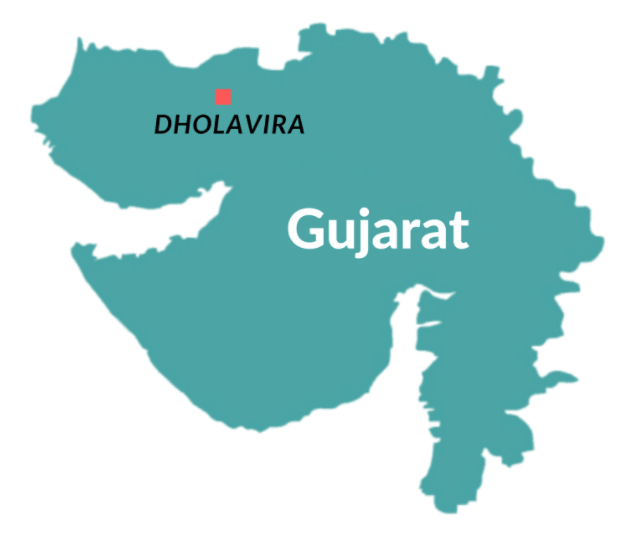
UNESCO has included Dholavira of Kutch in the list of World Heritage Sites in 2021, giving Gujarat the opportunity to shine once again on the World Heritage Map. With the inclusion of Dholavira in the World Heritage Site, Gujarat has also got the pride of being a state with four World Heritage Sites.
About The Location:
- the height of our civilization, our technological development, our social and material complexity, all signs point to progress, we often think. And yet, all is not as it seems and once in a while it occurs to us to look into the past to discover our future.
- Dholavira is the larger of the two most remarkable excavations of the Indus Valley Civilization or Harappan culture, dating back to 4500 years ago. While the other site, Lothal, is more exhaustively educated and easier to reach, a visit to Lothal only complements, rather than replaces, a visit to Dholavira. What this site offers you, in the intense environment that comes with being surrounded by the Great Rann of Kutch, is a unique insight into the pioneering Harappan mind, with one of the world’s earliest and best planned water conservation systems and what might be the world’s first signboards, written in ancient Indus script.
- The excavation also tells the story of the 7 stages of the civilization, from development to maturity to decay, the last of which hints at a strange piece of history, with more questions than answers. After the peak of the civilization Dholavira was temporarily abandoned, after which it seems that the settlers returned with a markedly de-urbanized culture. There are hints that they willingly chose to simplify their lives, rather than try to ride the collapse of their once glorified civilization. Here, on the ruins, you will have a chance to contemplate what progress and civilization mean and what, if anything, is truly permanent.
Background:
- Dholavira, known locally as Kotada (which means large fort), sprawls over 100 hectares of semi-arid land at the north-west corner of the island of Khadir, one of the islands in the Great Rann of Kutch that remain above the flood-plains in months when the rest of the desert is submerged by the monsoon. Dholavira has two seasonal nallahs, or streams: Mansar in the north, and Manhar in the south. The journey to Dholavira itself is beautiful, taking you through the saline desert plains of the Great Rann, where you can spot wildlife such as chinkara gazelle, nilgai (blue bull, the largest antelope in Asia), flamingos and other bird life.
- The site was unearthed by the Archeological Survey of India (ASI) in 1967, but has been systematically excavated only since 1990. Artifacts include terracotta pottery, beads, gold and copper ornaments, seals, fish hooks, animal figurines, tools, urns, and some imported vessels that indicate trade links with lands as far away as Mesopotamia. Also found were 10 large stone inscriptions, carved in Indus Valley script, perhaps the world’s earliest signboard. These are among the most important discoveries about the Indus Valley Civilization, but remain tantalizingly undeciphered.
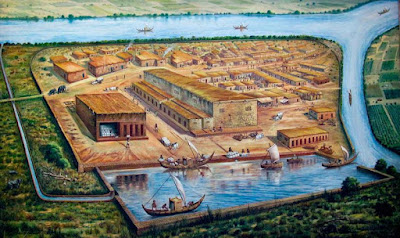
- The remains show an imposing citadel in the center, with a middle and lower town, each fortified separately, built with pleasingly smoothed structures of sun-dried brick and stone masonry, and with remarkable town planning. Well laid out lanes lead outward systematically from the citadel, with a well-constructed underground drainage system for sanitation. There is a large stadium with a complex structure and seating arrangement.
- Finally, Dholavira has one of the world’s earliest water conservation systems ever excavated. Satellite pictures show a reservoir underground, an expertly constructed rainwater harvesting system extending from the walls of the city, without which the settlement would not have thrived in the sparse rainfall of the desert.
- Dholavira is one of the two largest Harappan sites in India, and 5th largest in the subcontinent. Like Lothal, it passed through all the stages of the Harappan culture from circa 2900 BC to 1500 BC, while most others saw only the early or late stages.
- The excavation found a decline of the civilization in the 5th of 7th stages, after which were signs of a temporary desertion of the site. Settlers returned later in the late Harappan stage, with a change in their pottery, influenced by cultures found at sites in Sindh, South Rajasthan and other parts of Gujurat, but they did not bring the return of the civilization. Their houses, for example, were built in an entirely new form that was circular (bhungas), and the material signs were strikingly deurbanized and simplified. Perhaps the last stage of the powerful civilization had become aware of its future, and was preparing itself for a gradual end.
- Dholavira, the archaeological site of a Harappan-era city, received the UNESCO world heritage site tag on Tuesday. While Dholavira became the fourth site from Gujarat and 40th from India to make the list, it is the first site of the ancient Indus Valley Civilisation (IVC) in India to get the tag
Dholavira site
- The IVC acropolis is located on a hillock near present-day Dholavira village in Kutch district, from which it gets its name. It was discovered in 1968 by archaeologist Jagat Pati Joshi. The site’s excavation between 1990 and 2005 under the supervision of archaeologist Ravindra Singh Bisht uncovered the ancient city, which was a commercial and manufacturing hub for about 1,500 years before its decline and eventual ruin in 1500 BC.
- Distinct features
- After Mohen-jo-Daro, Ganweriwala and Harappa in Pakistan and Rakhigarhi in Haryana of India, Dholavira is the fifth largest metropolis of IVC. The site has a fortified citadel, a middle town and a lower town with walls made of sandstone or limestone instead of mud bricks in many other Harappan site
- Archaeologist Bisht cites a cascading series of water reservoirs, outer fortification, two multi-purpose grounds — one of which was used for festivities and as a marketplace — nine gates with unique designs, and funerary architecture featuring tumulus — hemispherical structures like the Buddhist Stupas— as some of the unique features of the Dholavira site.
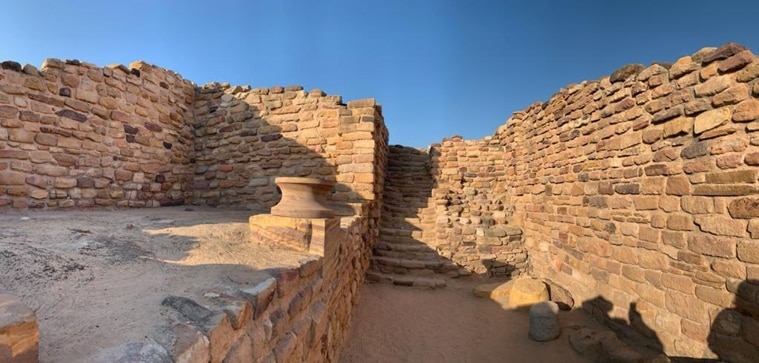
- Dholavira became the fourth site from Gujarat and 40th from India to make the list. (Twitter/narendramodi)
- He says that one finds the origin of the Buddhist Stupas in memorials in Dholavira.
- While unlike graves at other IVC sites, no mortal remains of humans have been discovered at Dholavira. Bisht says memorials that contain no bones or ashes but offerings of precious stones, etc. add a new dimension to the personality of the Harappans.
Rise and fall of Dholavira
- Remains of a copper smelter indicate of Harappans, who lived in Dholavira, knew metallurgy. It is believed that traders of Dholavira used to source copper ore from present-day Rajasthan and Oman and UAE and export finished products. It was also a hub of manufacturing jewellery made of shells and semi-precious stones, like agate and used to export timber.
- Bisht says that such beads peculiar to the Harappan workmanship have been found in the royal graves of Mesopotamia, indicating Dholavira used to trade with the Mesopotamians. Its decline also coincided with the collapse of Mesopotamia, indicating the integration of economies. Harappans, who were maritime people, lost a huge market, affecting the local mining, manufacturing, marketing and export businesses once Mesopotamia fell.
- He further says that from 2000 BC, Dholavira entered a phase of severe aridity due to climate change and rivers like Saraswati drying up. Because of a drought-like situation, people started migrating toward the Ganges valley or towards south Gujarat and further beyond in Maharashtra.
- In those times, Bisht says, the Great Rann of Kutch, which surrounds the Khadir island on which Dholavira is located, used to be navigable, but the sea receded gradually and the Rann became a mudflat.
Conservation
- Though it was excavated recently, the Dholavira site has remained free from encroachment in historical periods as well as in the modern era. Bisht says the UNESCO listing became possible because the site was found free from any kind of encroachment, a rarity in India.
- In its release, UNESCO termed Dholavira as one of the most remarkable and well-preserved urban settlements in South Asia dating from the 3rd to mid-2nd millennium BCE (Before Common Era). Since the excavation at the site, the ASI has developed a museum here. Dholavira, a village with a population of around 2,000, is the nearest human settlement at present. Near the ancient city is a fossil park where wood fossils are preserved.
Cultural (31)
Distinct Features of the Dholavira Site:
Decline of Dholavira:
Other World Sites in Gujarat
Natural (7)
Mixed (1)
How to get there
By Road
Ahmedabad is 335 ilometers from bhuj approx. driving time is 7 hours . Dholavira is 250 km from Bhuj and is reached via Bhachau and Rapar. A bus leaves from Bhuj at 14:00 and arrives at Dholavira at 20:30. It leaves at 05:00 the next morning and returns to Bhuj by 11:30. It is also possible to rent a vehicle.
By Train
The closest railway station to Dholavira is Samakhiali, just 137 kms away. Major railway stations nearby are Bhachau, Gandhidham and Anjar, which are 152, 187 and 191 Kms away respectively.
By Air
Major airports nearby are Kandla and Bhuj. Kandla airport stands at a distance of 191Kms, whereas Bhuj is around 215 kms away.
NEED ANY INFORMATION CONTACT ADM WONDERSINDIA@GMAIL.COM
UP DATES